
Your business data is one of your most valuable assets. But here's an uncomfortable question: will you still be able to open your files in 10 years? 20 years?
If you've ever tried to open an old WordPerfect document, a Lotus 1-2-3 spreadsheet, or a FreeHand illustration, you know the pain. The software is gone. The company is gone. And your data? Trapped in a format that modern tools can't read.
This isn't theoretical. It's a strategic risk that affects businesses of every size.
The Hidden Cost of Proprietary Formats
Proprietary file formats create what's called "software lock-in." Your data becomes hostage to a specific vendor's product.
When Adobe decides to sunset a product, your .fla files become archaeology. When Microsoft changes how Excel handles macros, your automated workflows break. When the startup behind your favorite design tool runs out of funding, your project files go dark.
The pattern repeats across industries. Law firms discover old case files are unreadable. Marketing teams can't access campaign assets from five years ago. Finance departments struggle to audit historical data locked in obsolete database formats.
Why Open Standards Matter
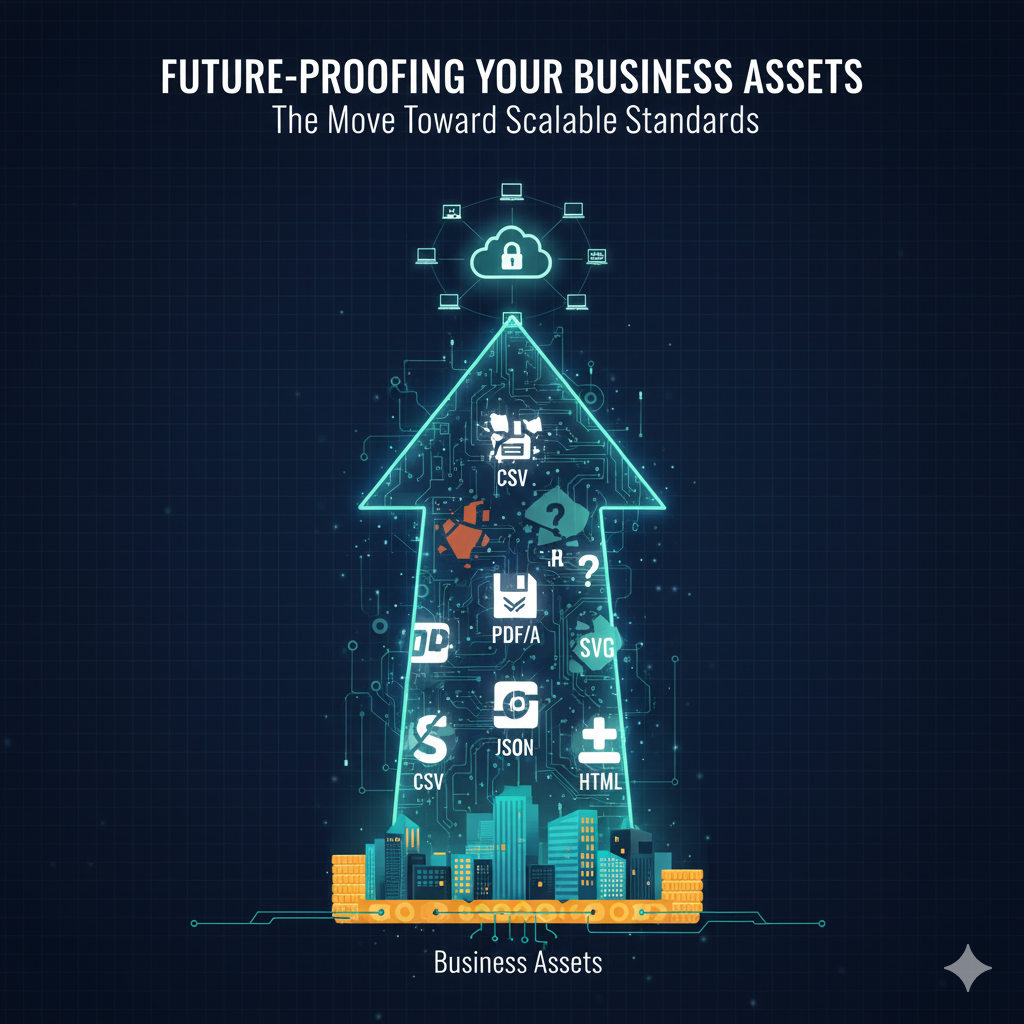
Open standards like SVG, CSV, PDF/A, and HTML work differently. Their specifications are publicly documented. Anyone can build tools to read and write them. They're maintained by standards bodies, not quarterly earnings reports.
Consider CSV, the humble comma-separated values file. It's been around since the 1970s. Every spreadsheet application on earth can open it. Every programming language has libraries to parse it. Your great-grandchildren will be able to read your CSV files because the format is so simple that nothing can make it obsolete.
SVG (Scalable Vector Graphics) offers similar durability for visual assets. Unlike proprietary formats like .ai or .cdr, SVG files are just XML text. You can open them in a text editor and understand exactly what's inside. They scale infinitely, work on the web, and will remain accessible as long as browsers exist.
A Practical Framework for File Format Decisions
Not every file needs to be in an open format. Here's how to think about it.
For archival data (financial records, legal documents, historical assets), prioritize open formats. CSV for tabular data. PDF/A for documents that need to preserve their appearance. SVG for graphics and diagrams.
For active work, use whatever tools make you most productive. Just build export processes into your workflow. Keep the master files where you need them, but maintain copies in open formats.
For data interchange (anything you share with partners, clients, or other systems), open formats reduce friction. A CSV will import into any system. A JSON file can be processed by any modern application.
The Web's Universal Language
The internet itself demonstrates why open standards win. HTML has evolved over 30 years while remaining backward compatible. A webpage from 1995 still renders in modern browsers. That's the power of open specifications maintained by the community rather than a single vendor.
When you build your business processes around open formats, you're building on that same foundation. Your tools can change. Your software can evolve. But your data remains accessible.
Making the Shift
You don't need to convert everything overnight. Start with these steps.
Audit your critical business data. Where are you storing information that would be catastrophic to lose? What format is it in? Can you open it without specific software?
Establish export routines. Whatever tools you use day-to-day, build regular exports to open formats into your workflow. Automated is better. Monthly backups to CSV or PDF/A cost nothing and buy insurance against an uncertain future.
Choose new tools wisely. When evaluating software, ask about export options. Can you get your data out in standard formats? If a vendor makes that difficult, that's a signal about their priorities.
The Long View
Businesses that last think in decades, not quarters. The companies that will still be thriving in 2050 are building systems today that don't depend on any single vendor's survival.
Your data deserves the same long-term thinking. Open formats aren't just a technical choice. They're a statement about how seriously you take the durability of your business.
The next time you save a file, ask yourself: will this still be readable when it matters most?
Fix42 builds tools around open standards because we believe your data should belong to you. Not just today, but forever. Explore our suite of converters and generators that help you work with formats designed to last.
Kingsley Michael
FounderCreator of Fix42, building free tools that solve everyday digital friction. Passionate about making powerful utilities accessible to everyone without subscriptions or data harvesting.
Share this article
Related Articles
The Format Nobody Wants But Everyone Needs: Why SVG Matters
SVG has a perception problem. It's "too complicated," "not worth it," or "just for designers." But ignoring SVG is costing you money, performance, and user experience. Here's the uncomfortable truth.
Why Your Designer Friend Won't Stop Talking About SVGs
Ever wonder why designers get so excited about SVGs? Here's the non-technical explanation of why vector graphics are actually pretty amazing (and why you should care).
The Great Format Wars: When JPG Met PNG at a WebP Party
A hilarious tale of image formats battling for digital supremacy, browser politics, and why your photos are having identity crises.
Mastering CSV Data Processing
Learn advanced techniques for handling large CSV files efficiently, including best practices for data validation, transformation, and analysis.
Discussion
Start the conversation
Leave a comment
Loading comments...